אלכסון קוונטי קרילוב של המילטוניאנים במבנה רשת
הערכת שימוש: 70 דקות על מעבד Heron או Nighthawk (הערה: זוהי הערכה בלבד. זמן הריצה שלך עשוי להשתנות.)
תוצרי למידה
-
כיצד לפרש אלכסון קוונטי קרילוב (KQD) כלמידה של פונקציית המילטוניאן סופית הפועלת כמסנן ספקטרלי.
-
כיצד לבנות את מטריצות ההמילטוניאן והחפיפה המוקרנות (projected) באמצעות מדידות extended swap-test.
-
כיצד לפתור את בעיית הערכים העצמיים המוכללת (GEVP) המתקבלת ולשחזר הערכת אנרגיית מצב יסוד עבור המילטוניאן במבנה רשת.
דרישות מוקדמות
רקע
מדריך זה מדגים כיצד ליישם את אלגוריתם האלכסון הקוונטי קרילוב (KQD) בהקשר של תבניות Qiskit. תחילה תלמד את התיאוריה מאחורי האלגוריתם ולאחר מכן תראה הדגמה של ביצועו על QPU.
הערכת התכונות באנרגיה נמוכה של המילטוניאנים מרובי-גופים היא משימה מרכזית בסימולציה קוונטית. לדוגמה, אנרגיות מצב יסוד והתעוררויות נמוכות קשורות ישירות ליציבות כימית, סדר מגנטי, מעברי פאזה קוונטיים, ותגובת החומר. במחשב קלאסי, ממד מרחב הילברט גדל באופן אקספוננציאלי עם מספר האורביטלים או הספינים, כך שאלכסון ישיר הופך במהירות ללא מעשי.
קיימות מספר גישות מחשוב קוונטי לבעיה זו. שיטות וריאציוניות לטווח קרוב, כגון פותר הערכים העצמיים הוריאציוני הקוונטי (VQE), משתמשות ב-Circuits פרמטריים רדודים יחסית, אך הן דורשות לולאת אופטימיזציה קלאסית לא-לינארית עם הערכות Circuit קוונטי רבות. בקצה השני, הערכת פאזה קוונטית (QPE) מספקת דרך ישירה יותר להערכת ערכים עצמיים עם הבטחות קפדניות, אך QPE הסטנדרטי דורש Circuits קוהרנטיים ארוכים ומתאים בעיקר למחשבים קוונטיים סובלניים לתקלות. KQD ממוקם בין שתי הגישות הללו: הוא משתמש באבולוציית המילטוניאן בזמן אמת, כמו באלגוריתמים מבוססי הערכת פאזה, אך מחליף הערכת פאזה מלאה בבעיית ערכים עצמיים מוקרנת קומפקטית שניתן לפתור באופן קלאסי.
נתבונן בהמילטוניאן בן Qubit ובמצב ייחוס . שיטת KQD בונה תת-מרחב קרילוב ממצבים שהתפתחו בזמן אמת,
כאשר הוא ממד קרילוב ו- הוא צעד הזמן. כל מצב בתת-מרחב קרילוב מיוצג אז כצירוף לינארי של מצבי הבסיס הללו,
where the denominator normalizes the state.
באמצעות אלגברה פשוטה, אנו יכולים לראות שהאנרגיה המתאימה נכתבת כמנת ריילי (Rayleigh quotient),
כאן, המטריצות ו-,
מגדירות את מטריצות החפיפה וההמילטוניאן המוקרנות. הערכים שלהן מוערכים באמצעות מדידות Circuit קוונטי.
אנו שואפים למצוא את המקדם שנותן את המינימום של :
לפי משפט ריילי-ריץ (Rayleigh-Ritz), מזעור זה שקול לפתרון בעיית הערכים העצמיים המוכללת (GEVP),
שים לב שהממד יכול להיות קטן מספיק כדי שמחשב קלאסי יוכל לפתור את ה-GEVP.
זהו אותו עקרון וריאציוני המשמש באלכסון תת-מרחב קלאסי, אך כאן מצבי הבסיס נוצרים על ידי אבולוציית זמן קוונטית. בהשוואה ל-VQE, KQD בדרך כלל דורש Circuits עמוקים יותר מכיוון שהוא מסתמך על אבולוציה בזמן אמת. בתמורה, KQD נמנע מאופטימיזציית פרמטרים לא-לינארית וביצוע איטרטיבי על חומרה קוונטית, והוא משתפר באופן שיטתי ככל שתת-המרחב המוקרן מוגדל. האלגוריתם הודגם בקנה מידה גדול על חומרה קוונטית קיימת [2], וניתן לנתח את הביצועים שלו עם הבטחות ניתנות להוכחה [1].
דרישות
לפני התחלת מדריך זה, ודא שיש לך את הדברים הבאים מותקנים:
-
Qiskit SDK v2.3 ומעלה עם תמיכה בvisualization
-
Qiskit Runtime v0.22 או מאוחר יותר (
pip install qiskit-ibm-runtime) -
SciPy (
pip install scipy) -
Matplotlib (
pip install matplotlib) -
Pandas (
pip install pandas)
ביצוע על חומרה דורש qiskit-ibm-runtime וגישה לחשבון IBM Quantum®.
הגדרה
תא ההגדרה מייבא את המודולים הנדרשים ומגדיר פונקציות עזר לזרימת העבודה:
-
בניית המילטוניאן הייזנברג;
-
פתרון ה-GEVP עם סף (thresholded);
-
הערכת מסנן קרילוב שנלמד;
-
המרת ערכי המסנן למשקלים ספקטרליים;
-
שרטוט התפלגויות האנרגיה של הייחוס והמסוננות.
# Added by doQumentation — installs the packages this notebook needs if they are missing
import importlib.util

_needed = {"matplotlib": "matplotlib", "numpy": "numpy", "pandas": "pandas", "qiskit": "qiskit", "qiskit_ibm_runtime": "qiskit-ibm-runtime", "scipy": "scipy"}
_missing = [pip for module, pip in _needed.items()
            if importlib.util.find_spec(module) is None]
# One at a time, so a package that fails to install does not block the others
for _pip in _missing:
    %pip install -q {_pip}
if not _missing:
    print("\u2713 All required packages are installed")
from __future__ import annotations

import warnings

import numpy as np
import pandas as pd
import scipy.linalg as la
import matplotlib.pyplot as plt

from qiskit import QuantumCircuit, transpile
from qiskit.circuit import Parameter
from qiskit.circuit.library import PauliEvolutionGate
from qiskit.primitives import StatevectorEstimator
from qiskit.quantum_info import Operator, SparsePauliOp
from qiskit.synthesis import LieTrotter, SuzukiTrotter
from qiskit.transpiler import PassManager, Layout
from qiskit.transpiler.passes import CommutativeOptimization
from qiskit.transpiler.preset_passmanagers import generate_preset_pass_manager
from qiskit_ibm_runtime import QiskitRuntimeService, EstimatorV2, Batch
from qiskit_ibm_runtime.fake_provider import FakeMarrakesh

warnings.filterwarnings("ignore")

def make_heisenberg_hamiltonian(
    num_qubits: int,
    coupling: float = 1.0,
) -> SparsePauliOp:
    """Make a Heisenberg Hamiltonian for a 1D chain of qubits with nearest-neighbor interactions."""
    terms: list[tuple[str, complex]] = []

    def append_term(q0: int, q1: int, pauli: str):
        label = ["I"] * num_qubits
        label[num_qubits - 1 - q0] = pauli[0]
        label[num_qubits - 1 - q1] = pauli[1]
        terms.append(("".join(label), coupling))

    for pauli in ("XX", "YY", "ZZ"):
        for q in range(num_qubits - 1):
            append_term(q, q + 1, pauli)
    return SparsePauliOp.from_list(terms).simplify()

def _basis_state_transition_amplitude_sparse(
    hamiltonian: SparsePauliOp,
    bra_state: int,
    ket_state: int,
) -> complex:
    """Evaluate <bra_state|H|ket_state> for computational-basis states."""
    num_qubits = hamiltonian.num_qubits
    amplitude = 0.0 + 0.0j
    for pauli, coeff in zip(hamiltonian.paulis, hamiltonian.coeffs):
        new_state = ket_state
        phase = 1.0 + 0.0j
        for q in range(num_qubits):
            x = bool(pauli.x[q])
            z = bool(pauli.z[q])
            if not x and not z:
                continue
            bit = (new_state >> q) & 1
            if x and z:
                # Y|0> = i|1>, Y|1> = -i|0>
                phase *= 1j if bit == 0 else -1j
                new_state ^= 1 << q
            elif x:
                new_state ^= 1 << q
            else:
                # Z|0> = |0>, Z|1> = -|1>
                if bit:
                    phase *= -1
        if new_state == bra_state:
            amplitude += coeff * phase
    return amplitude

def basis_state_expectation_sparse(
    hamiltonian: SparsePauliOp,
    bitstring: str,
) -> complex:
    """Evaluate <bitstring|H|bitstring>."""
    state = int(bitstring, 2)
    return _basis_state_transition_amplitude_sparse(
        hamiltonian,
        bra_state=state,
        ket_state=state,
    )

def diagonalize_single_1_subspace(
    hamiltonian: SparsePauliOp,
) -> np.ndarray:
    """Diagonalize the Hamiltonian projected onto the single-excitation subspace."""
    num_qubits = hamiltonian.num_qubits

    # Integer basis states |...010...>, with the excitation at qubit k.
    basis = [1 << k for k in range(num_qubits)]

    h_single = np.empty((num_qubits, num_qubits), dtype=complex)

    for row, bra_state in enumerate(basis):
        for col, ket_state in enumerate(basis):
            h_single[row, col] = _basis_state_transition_amplitude_sparse(
                hamiltonian,
                bra_state=bra_state,
                ket_state=ket_state,
            )
    # Remove floating-point-level asymmetry.
    h_single = 0.5 * (h_single + h_single.conj().T)
    evals, _ = np.linalg.eigh(h_single)
    return np.real(evals)

def simple_transpilation(circuit: QuantumCircuit) -> QuantumCircuit:
    """Transpilation to simplify the circuit"""
    pm = PassManager(
        [
            CommutativeOptimization(),
        ]
    )
    circuit = transpile(circuit, optimization_level=3)
    circuit = pm.run(circuit)
    return circuit

def summarize_circuit(circuit: QuantumCircuit) -> dict[str, int | str]:
    """Summarize the circuit with depth, size, and 2-qubit gate information."""
    two_qubit_total = sum(
        inst.operation.num_qubits == 2 for inst in circuit.data
    )
    two_qubit_depth = circuit.depth(lambda x: x[0].num_qubits == 2)
    return {
        "depth": circuit.depth(),
        "size": circuit.size(),
        "2q gates": two_qubit_total,
        "2q depth": two_qubit_depth,
    }

def solve_thresholded_gevp(
    h_matrix: np.ndarray,
    s_matrix: np.ndarray,
    threshold: float = 1e-10,
) -> tuple[float, np.ndarray, int]:
    """Solve H c = E S c using canonical orthogonalization of S."""
    s_vals, s_vecs = la.eigh(s_matrix)

    valid = s_vals > threshold
    if not np.any(valid):
        raise ValueError(
            "All overlap eigenvalues were removed by thresholding."
        )

    keep = valid

    orthogonalizer = s_vecs[:, keep] @ np.diag(1.0 / np.sqrt(s_vals[keep]))
    h_orth = orthogonalizer.conj().T @ h_matrix @ orthogonalizer
    h_orth = 0.5 * (h_orth + h_orth.conj().T)

    eigvals, eigvecs = la.eigh(h_orth)

    coeffs = orthogonalizer @ eigvecs[:, 0]
    normalization = np.sqrt(np.real(coeffs.conj().T @ s_matrix @ coeffs))
    coeffs /= normalization

    return float(np.real(eigvals[0])), coeffs, int(np.sum(keep))
בחלק הראשון של מדריך זה, אנו מדגימים את שיטת KQD באמצעות סימולטור וקטור-מצב מקומי. בהמשך, אנו משתמשים ב-Backend קוונטי אמיתי כדי להתמודד עם בעיה בקנה מידה שימושי (utility-scale).
אנו גם מגדירים Backend מדומה (fake) כדי להדגים טרנספילציה (transpilation) ספציפית ל-Backend ולבחון את ה-Circuit המתקבל.
try:
    service = QiskitRuntimeService()
except Exception:
    QiskitRuntimeService.save_account(
        token="<api_token>", instance="<instance>", overwrite=True
    )
    service = QiskitRuntimeService()

backend = FakeMarrakesh()
דוגמת סימולטור בקנה מידה קטן
שלב 1: מיפוי קלטים קלאסיים לבעיה קוונטית
המילטוניאן ומצב ייחוס
דוגמה זו משתמשת בשרשרת הייזנברג עם גבול פתוח בת 12 Qubit (),
עם מצב מכפלה בעל התעוררות בודדת
כמצב הייחוס. מכיוון שהמילטוניאן הייזנברג שהוגדר לעיל משמר את מספר ההתעוררויות הכולל, מצב הייחוס נשאר בתת-המרחב של התעוררות בודדת, שממדו גדל רק באופן לינארי עם מספר ה-Qubit. לכן אנו יכולים לחשב את אנרגיית מצב היסוד המדויקת ביעילות, על ידי אלכסון ההמילטוניאן המוגבל לתת-מרחב זה, ולהשתמש בה אך ורק כבנצ'מרק אבחוני להערכת KQD. זרימת העבודה של KQD עצמה מעריכה איברי מטריצה מוקרנים באמצעות Qiskit primitives ופותרת את הבעיה המוקרנת המתקבלת באופן קלאסי.
# Problem definition for the simulator example
num_qubits = 12
hamiltonian = make_heisenberg_hamiltonian(num_qubits=num_qubits, coupling=1.0)
ref_bitstring = "000001000000"
ref_energy = basis_state_expectation_sparse(hamiltonian, ref_bitstring)

print("Hamiltonian:")
print(hamiltonian)
print(f"Reference state: |{ref_bitstring}>")
print("Reference energy: ", ref_energy)
Hamiltonian:
SparsePauliOp(['IIIIIIIIIIXX', 'IIIIIIIIIXXI', 'IIIIIIIIXXII', 'IIIIIIIXXIII', 'IIIIIIXXIIII', 'IIIIIXXIIIII', 'IIIIXXIIIIII', 'IIIXXIIIIIII', 'IIXXIIIIIIII', 'IXXIIIIIIIII', 'XXIIIIIIIIII', 'IIIIIIIIIIYY', 'IIIIIIIIIYYI', 'IIIIIIIIYYII', 'IIIIIIIYYIII', 'IIIIIIYYIIII', 'IIIIIYYIIIII', 'IIIIYYIIIIII', 'IIIYYIIIIIII', 'IIYYIIIIIIII', 'IYYIIIIIIIII', 'YYIIIIIIIIII', 'IIIIIIIIIIZZ', 'IIIIIIIIIZZI', 'IIIIIIIIZZII', 'IIIIIIIZZIII', 'IIIIIIZZIIII', 'IIIIIZZIIIII', 'IIIIZZIIIIII', 'IIIZZIIIIIII', 'IIZZIIIIIIII', 'IZZIIIIIIIII', 'ZZIIIIIIIIII'],
              coeffs=[1.+0.j, 1.+0.j, 1.+0.j, 1.+0.j, 1.+0.j, 1.+0.j, 1.+0.j, 1.+0.j, 1.+0.j,
 1.+0.j, 1.+0.j, 1.+0.j, 1.+0.j, 1.+0.j, 1.+0.j, 1.+0.j, 1.+0.j, 1.+0.j,
 1.+0.j, 1.+0.j, 1.+0.j, 1.+0.j, 1.+0.j, 1.+0.j, 1.+0.j, 1.+0.j, 1.+0.j,
 1.+0.j, 1.+0.j, 1.+0.j, 1.+0.j, 1.+0.j, 1.+0.j])
Reference state: |000001000000>
Reference energy:  (7+0j)
הגדרת פרמטרים לאלגוריתם
בהתבסס על הגבולות העליונים על נורמת ההמילטוניאן, מקור [1] מציע באופן היוריסטי את צעד הזמן כ-. מכיוון שקשה לחשב את הנורמה הספקטרלית , אנו משתמשים במקום זאת בגבול העליון שלה:
אנו קובעים את ממד קרילוב ל- ואת מספר צעדי Trotter לכל צעד זמן ל-: מרחב קרילוב גדול מספיק כדי לפתור את הספקטרום הנמוך תוך שמירה על ה-Circuit העמוק ביותר () במחיר סביר, ומספיק צעדי Trotter כדי לשמור על שגיאת הדיסקרטיזציה קטנה באותו Circuit עמוק ביותר.
dt = np.pi / (3 * (num_qubits - 1))
print("dt in Krylov basis:  ", dt)

krylov_dim = 10
num_trotter_steps = 5
dt in Krylov basis: 0.09519977738150888
בניית Circuit
כאן, אנו בונים את ה-Circuits להערכת איברי המטריצה ו-. מכיוון שכל החזקות של מתחלפות (commute), יש לנו
מטריצות כאלה, שבהן האיברים תלויים בהפרשי האינדקסים באופן הזה, נקראות מטריצות Toeplitz, וניתן לשחזר אותן מאיברי השורה הראשונה, המסומנים באינדקס .
כאן, אנו מציגים את ה-Circuit, הנקרא extended-swap-test, שמכין
כאשר .
מצב ייחוס
אנו מכינים את מצב הייחוס .
qc_ref = QuantumCircuit(num_qubits)
for i, b in enumerate(reversed(ref_bitstring)):
    if b == "1":
        qc_ref.x(i)
display(qc_ref.draw("mpl", scale=0.5))

אבולוציית זמן
ממש את אופרטור האבולוציה בזמן שנוצר על ידי ההמילטוניאן, מקורב באמצעות Lie-Trotterization פשוט.
t = Parameter("t")

evol_gate = PauliEvolutionGate(
    hamiltonian,
    time=t,
    synthesis=LieTrotter(reps=num_trotter_steps),
    label="U(t)",
)

# Synthesize U(t) first and then control the synthesized circuit.
# This makes the controlled structure visible in the circuit drawer.
evolution_circuit = QuantumCircuit(num_qubits, name="U(t)")
evolution_circuit.append(evol_gate, range(num_qubits))
evolution_circuit = simple_transpilation(evolution_circuit)

# Make a controlled version of the evolution circuit.
controlled_evolution_gate = evolution_circuit.to_gate(label="U(t)").control(
    1, label="C-U(t)"
)
display(
    evolution_circuit.assign_parameters({t: 1.5}).draw(
        "mpl", scale=0.5, fold=-1
    )
)

Circuit של extended swap test [3]
ה-Circuit תחילה מכין את מצב הייחוס על רגיסטר המערכת בעוד האנסילה (ancilla) נשארת ב-:
לאחר מכן, הפעלת Gate של הדמר (Hadamard) על האנסילה יוצרת סופרפוזיציה קוהרנטית של שני ענפים:
לבסוף, ה-Gate של אבולוציית הזמן המבוקרת מפעיל:
רק כאשר האנסילה נמצאת בענף . לכן,
בבלוק הקוד הבא, אנו מיישמים:
אשר יוקצה כ- עבור בשלב הביצוע.
ancilla = 0
system_qubits = list(range(1, num_qubits + 1))

extended_swap_test = QuantumCircuit(num_qubits + 1)

# Append state preparation part
extended_swap_test = extended_swap_test.compose(qc_ref, system_qubits)

# Prepare the coherent branch label, (|0> + |1>) / sqrt(2).
extended_swap_test.h(ancilla)

# Apply U(t) only to the |1> branch of the ancilla.
extended_swap_test.append(
    controlled_evolution_gate, [ancilla] + system_qubits
)

# Decompose once more for visualization so that control bullets are visible.
display(extended_swap_test.draw("mpl", fold=-1))

אובזרבלים
עבור כל אובזרבל הרמיטי של המערכת , כאן אנו קובעים את האובזרבלים לחישוב:
זאת מכיוון ש- נותן את איבר החפיפה , בעוד ש- נותן את איבר ההמילטוניאן .
באמצעות , יש לנו
באופן דומה, באמצעות ,
לכן, יש לנו
לבסוף, עבור כל מצב , עלינו למדוד:
n_qubits = hamiltonian.num_qubits

observable_labels = [
    "Re S_0d",
    "Im S_0d",
    "Re H_0d",
    "Im H_0d",
]

# X ⊗ I and Y ⊗ I.
# Qiskit's Pauli-label convention places qubit 0 on the rightmost character,
# so the ancilla Pauli is appended to the right.
obs_x_identity = SparsePauliOp("I" * n_qubits + "X")
obs_y_identity = SparsePauliOp("I" * n_qubits + "Y")

# X ⊗ H and Y ⊗ H.
obs_x_hamiltonian = SparsePauliOp.from_list(
    [
        (label + "X", coeff)
        for label, coeff in zip(
            hamiltonian.paulis.to_labels(),
            hamiltonian.coeffs,
        )
    ]
)

obs_y_hamiltonian = SparsePauliOp.from_list(
    [
        (label + "Y", coeff)
        for label, coeff in zip(
            hamiltonian.paulis.to_labels(),
            hamiltonian.coeffs,
        )
    ]
)

observables = [
    obs_x_identity,
    obs_y_identity,
    obs_x_hamiltonian,
    obs_y_hamiltonian,
]

for obs, label in zip(observables, observable_labels):
    print(f"Observable: {label}")
    print(obs)
    print()
Observable: Re S_0d
SparsePauliOp(['IIIIIIIIIIIIX'],
              coeffs=[1.+0.j])

Observable: Im S_0d
SparsePauliOp(['IIIIIIIIIIIIY'],
              coeffs=[1.+0.j])

Observable: Re H_0d
SparsePauliOp(['IIIIIIIIIIXXX', 'IIIIIIIIIXXIX', 'IIIIIIIIXXIIX', 'IIIIIIIXXIIIX', 'IIIIIIXXIIIIX', 'IIIIIXXIIIIIX', 'IIIIXXIIIIIIX', 'IIIXXIIIIIIIX', 'IIXXIIIIIIIIX', 'IXXIIIIIIIIIX', 'XXIIIIIIIIIIX', 'IIIIIIIIIIYYX', 'IIIIIIIIIYYIX', 'IIIIIIIIYYIIX', 'IIIIIIIYYIIIX', 'IIIIIIYYIIIIX', 'IIIIIYYIIIIIX', 'IIIIYYIIIIIIX', 'IIIYYIIIIIIIX', 'IIYYIIIIIIIIX', 'IYYIIIIIIIIIX', 'YYIIIIIIIIIIX', 'IIIIIIIIIIZZX', 'IIIIIIIIIZZIX', 'IIIIIIIIZZIIX', 'IIIIIIIZZIIIX', 'IIIIIIZZIIIIX', 'IIIIIZZIIIIIX', 'IIIIZZIIIIIIX', 'IIIZZIIIIIIIX', 'IIZZIIIIIIIIX', 'IZZIIIIIIIIIX', 'ZZIIIIIIIIIIX'],
              coeffs=[1.+0.j, 1.+0.j, 1.+0.j, 1.+0.j, 1.+0.j, 1.+0.j, 1.+0.j, 1.+0.j, 1.+0.j,
 1.+0.j, 1.+0.j, 1.+0.j, 1.+0.j, 1.+0.j, 1.+0.j, 1.+0.j, 1.+0.j, 1.+0.j,
 1.+0.j, 1.+0.j, 1.+0.j, 1.+0.j, 1.+0.j, 1.+0.j, 1.+0.j, 1.+0.j, 1.+0.j,
 1.+0.j, 1.+0.j, 1.+0.j, 1.+0.j, 1.+0.j, 1.+0.j])

Observable: Im H_0d
SparsePauliOp(['IIIIIIIIIIXXY', 'IIIIIIIIIXXIY', 'IIIIIIIIXXIIY', 'IIIIIIIXXIIIY', 'IIIIIIXXIIIIY', 'IIIIIXXIIIIIY', 'IIIIXXIIIIIIY', 'IIIXXIIIIIIIY', 'IIXXIIIIIIIIY', 'IXXIIIIIIIIIY', 'XXIIIIIIIIIIY', 'IIIIIIIIIIYYY', 'IIIIIIIIIYYIY', 'IIIIIIIIYYIIY', 'IIIIIIIYYIIIY', 'IIIIIIYYIIIIY', 'IIIIIYYIIIIIY', 'IIIIYYIIIIIIY', 'IIIYYIIIIIIIY', 'IIYYIIIIIIIIY', 'IYYIIIIIIIIIY', 'YYIIIIIIIIIIY', 'IIIIIIIIIIZZY', 'IIIIIIIIIZZIY', 'IIIIIIIIZZIIY', 'IIIIIIIZZIIIY', 'IIIIIIZZIIIIY', 'IIIIIZZIIIIIY', 'IIIIZZIIIIIIY', 'IIIZZIIIIIIIY', 'IIZZIIIIIIIIY', 'IZZIIIIIIIIIY', 'ZZIIIIIIIIIIY'],
              coeffs=[1.+0.j, 1.+0.j, 1.+0.j, 1.+0.j, 1.+0.j, 1.+0.j, 1.+0.j, 1.+0.j, 1.+0.j,
 1.+0.j, 1.+0.j, 1.+0.j, 1.+0.j, 1.+0.j, 1.+0.j, 1.+0.j, 1.+0.j, 1.+0.j,
 1.+0.j, 1.+0.j, 1.+0.j, 1.+0.j, 1.+0.j, 1.+0.j, 1.+0.j, 1.+0.j, 1.+0.j,
 1.+0.j, 1.+0.j, 1.+0.j, 1.+0.j, 1.+0.j, 1.+0.j])
עבור הערכת איברי המטריצה , מספר איברי פאולי גדול הרבה יותר מזה של איברי המטריצה .
כעת אנו יכולים להפחית את מספר איברי ההמילטוניאן הנמדדים באמצעות טכניקת הזזה (shifting) [4]. אנו מפצלים את ההמילטוניאן כך:
כאשר נבחר כך שמצב הייחוס הוא הווקטור העצמי שלו,
Then,
Here,
הוא איבר המטריצה של ההמילטוניאן המוזז. לכן, עלינו למדוד רק את ו-. התרומה מ- משוחזרת באופן קלאסי באמצעות איבר מטריצת החפיפה שכבר נמדד .
בדוגמה זו, בחירה טבעית היא החלק האלכסוני של המילטוניאן הייזנברג,
מכיוון שמצב הייחוס הוא מצב בסיס חישובי, הוא וקטור עצמי של כל איבר .
עם זאת, בחירה מועילה יותר היא לכלול לא רק את איברי האלכסוניים, אלא גם את איברי שמאפסים (annihilate) את מצב הייחוס.
עבור כל זוג שכנים, האופרטור מקיים
and
לכן, איבר תורם רק כאשר לשני ה-Qubit השכנים יש אכלוסים שונים במחרוזת הביטים של הייחוס. אם שני ה-Qubit הם שניהם או שניהם , האיבר מאפס את מצב הייחוס וניתן גם להזיז אותו החוצה.
יהי , כאשר . לכן, אנו יכולים לבחור
אופרטור זה עדיין מקיים
מכיוון שאיברי פועלים באופן אלכסוני על , בעוד שאיברי המוזזים נותנים אפס. הערך העצמי המתאים נקבע אם כן רק על ידי איברי ,
עם בחירה זו, ההמילטוניאן המוזז הופך ל:
כתוצאה מכך, רק הקשתות (edges) עם אכלוסים שונים במצב הייחוס צריכות להימדד. כל איברי וכל איברי הלא-פעילים משוחזרים דרך תרומת החפיפה , או נותנים תרומה אפסית מעצם הבנייה.
זה נותן אובזרבל קטן יותר מהזזת החלק האלכסוני בלבד. בפרט, עבור מצב ייחוס בבסיס חישובי עם התעוררות ממוקמת, רק הקשתות הסמוכות להתעוררות נשארות ב-. לכן, ניתן להפחית משמעותית את מספר איברי פאולי ב- וב-, בעוד שאיבר המטריצה המשוחזר
נשאר בדיוק זהה.
def make_reduced_heisenberg_observables(
    ref_bitstring: str,
    coupling: float = 1.0,
) -> tuple[SparsePauliOp, SparsePauliOp, float]:
    """Build X⊗(H-T), Y⊗(H-T), and tau."""
    n_qubits = len(ref_bitstring)

    shifted_terms: list[tuple[str, complex]] = []
    tau = 0.0

    def bit(q: int) -> str:
        return ref_bitstring[n_qubits - 1 - q]

    def append_term(q0: int, q1: int, pauli: str):
        label = ["I"] * n_qubits
        label[n_qubits - 1 - q0] = pauli[0]
        label[n_qubits - 1 - q1] = pauli[1]
        shifted_terms.append(("".join(label), coupling))

    for q in range(n_qubits - 1):
        same_occupation = bit(q) == bit(q + 1)

        # ZZ contribution to tau
        tau += coupling * (1.0 if same_occupation else -1.0)

        # XX + YY survives only for opposite occupations.
        if not same_occupation:
            append_term(q, q + 1, "XX")
            append_term(q, q + 1, "YY")

    if shifted_terms:
        obs_x_shifted_hamiltonian = SparsePauliOp.from_list(
            [(label + "X", coeff) for label, coeff in shifted_terms]
        )
        obs_y_shifted_hamiltonian = SparsePauliOp.from_list(
            [(label + "Y", coeff) for label, coeff in shifted_terms]
        )
    else:
        obs_x_shifted_hamiltonian = SparsePauliOp(
            "I" * n_qubits + "X", coeffs=[0.0]
        )
        obs_y_shifted_hamiltonian = SparsePauliOp(
            "I" * n_qubits + "Y", coeffs=[0.0]
        )

    return obs_x_shifted_hamiltonian, obs_y_shifted_hamiltonian, tau

obs_x_shifted_hamiltonian, obs_y_shifted_hamiltonian, shift_tau = (
    make_reduced_heisenberg_observables(ref_bitstring)
)

print("Observable: Re shifted H_0d")
print(obs_x_shifted_hamiltonian)
print()

print("Observable: Im shifted H_0d")
print(obs_y_shifted_hamiltonian)
print()

print("tau =", shift_tau)

observables = [
    obs_x_identity,
    obs_y_identity,
    obs_x_shifted_hamiltonian,
    obs_y_shifted_hamiltonian,
]
observable_labels = [
    "Re S_0d",
    "Im S_0d",
    "Re shifted H_0d",
    "Im shifted H_0d",
]
Observable: Re shifted H_0d
SparsePauliOp(['IIIIIXXIIIIIX', 'IIIIIYYIIIIIX', 'IIIIXXIIIIIIX', 'IIIIYYIIIIIIX'],
              coeffs=[1.+0.j, 1.+0.j, 1.+0.j, 1.+0.j])

Observable: Im shifted H_0d
SparsePauliOp(['IIIIIXXIIIIIY', 'IIIIIYYIIIIIY', 'IIIIXXIIIIIIY', 'IIIIYYIIIIIIY'],
              coeffs=[1.+0.j, 1.+0.j, 1.+0.j, 1.+0.j])

tau = 7.0
שלב 2: אופטימיזציה של הבעיה לביצוע על חומרה קוונטית
כעת אנו הופכים את ה-Circuit המופשט של extended-swap-test לתבנית מכוונת-חומרה. לפני כן, אנו מבצעים אופטימיזציה נוספת ל-Circuit ברמה המופשטת קודם.
השוואת סידור איברי ההמילטוניאן
ראשית, אנו משווים סידורים שונים של איברי פאולי בהמילטוניאן הייזנברג עבור סימולציית ההמילטוניאן. ההמילטוניאן עצמו אינו משתנה, אך הסידור משפיע על אופן היצירה של Circuit נוסחת המכפלה (product-formula) ועד כמה ניתן להריץ את המבנה במקביל ב-Circuit. לדוגמה, הסידור הנאיבי מפרט את כל איברי של השכנים הקרובים ביותר, ואז את כל איברי , ואז את כל איברי . זה ממקם קשתות סמוכות כמו ו- זו לצד זו, כך שלא ניתן להריץ אותן במקביל. הסידור זוגי-ואז-אי-זוגי (even-then-odd) מבקר תחילה בקשתות זוגיות זרות, ולאחר מכן בקשתות אי-זוגיות, מה שחושף שכבות דו-Qubit מקבילות. הסידור המקובץ-לפי-קשתות זוגי-אי-זוגי הולך צעד אחד קדימה: עבור כל קשת, הוא שומר את איברי , ו- המקומיים יחד, תוך שהוא עדיין מבקר בקשתות זוגיות לפני קשתות אי-זוגיות. אנו מצפים שהסידורים זוגי-ואז-אי-זוגי והמקובץ-לפי-קשתות זוגי-אי-זוגי יפחיתו את עומק ה-Circuit על ידי חשיפת שכבות דו-Qubit מקבילות, ושהסידור המקובץ-לפי-קשתות יפחית בנוסף את שגיאת Trotter מכיוון שהאינטראקציה הדו-Qubit המקומית על אותה קשת מטופלת כבלוק קומפקטי.
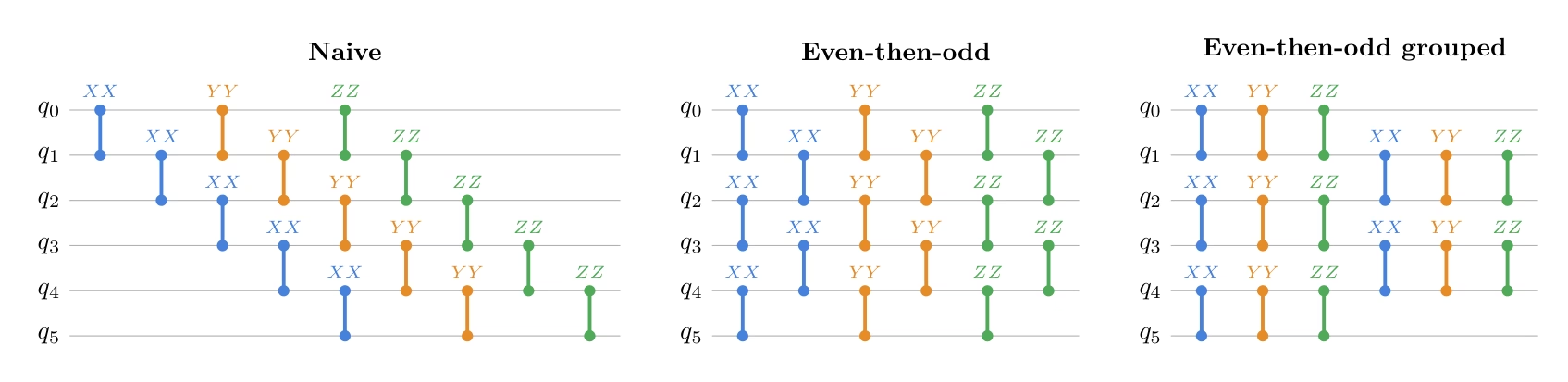
סידור ההמילטוניאן משפיע גם על שגיאת Trotter. אם אנו ממקמים איברים שאינם מתחלפים (noncommuting) זה לצד זה, מעברי הבסיס מתרחשים לעיתים קרובות יותר, מה שגורם ליותר שגיאת Trotter. על ידי קיבוץ איברים הדורשים את אותה טרנספורמציית בסיס-פאולי, ניתן להימנע משינויי בסיס מיותרים.
כאן, ההשוואה משתמשת בזמן האבולוציה הגדול ביותר שמופיע בהערכות קרילוב של השורה הראשונה, תוך שימוש באותו תנאי טרנספילציה (transpilation).
על מנת למדוד את שגיאת Trotter, אנו משתמשים ב-אי-נאמנות תהליך (process infidelity) בין ה-Circuit המבוסס-Trotter (Trotterized) לבין אבולוציית ההמילטוניאן המדויקת,
where is the dimension of the Hilbert space.
אבחון זה משתמש במטריצות צפופות, ולכן הוא מתאים לדוגמה הקטנה הזו בת 12 Qubit אך אינו מיועד כתת-שגרה הניתנת להרחבה.
# The comparison uses the largest time that appears in the first-row Krylov estimates.
# Circuit depth does not depend on this numeric value, but the Trotter error does.
comparison_time = (krylov_dim - 1) * dt

def make_heisenberg_hamiltonian_ordered(
    num_qubits: int,
    ordering: str,
    coupling: float = 1.0,
) -> SparsePauliOp:
    """Return the same Heisenberg Hamiltonian with a specified term ordering."""
    terms: list[tuple[str, complex]] = []
    even_edges = [(q, q + 1) for q in range(0, num_qubits - 1, 2)]
    odd_edges = [(q, q + 1) for q in range(1, num_qubits - 1, 2)]

    def append_term(q0: int, q1: int, pauli: str):
        label = ["I"] * num_qubits
        label[num_qubits - 1 - q0] = pauli[0]
        label[num_qubits - 1 - q1] = pauli[1]
        terms.append(("".join(label), coupling))

    if ordering == "naive":
        for pauli in ("XX", "YY", "ZZ"):
            for q in range(num_qubits - 1):
                append_term(q, q + 1, pauli)
    elif ordering == "even-then-odd":
        for pauli in ("XX", "YY", "ZZ"):
            for q0, q1 in even_edges + odd_edges:
                append_term(q0, q1, pauli)
    elif ordering == "even-odd edge-grouped":
        for q0, q1 in even_edges + odd_edges:
            for pauli in ("XX", "YY", "ZZ"):
                append_term(q0, q1, pauli)
    else:
        raise ValueError(f"Unknown ordering: {ordering}")

    return SparsePauliOp.from_list(terms).simplify()

def build_numeric_evolution_circuit(
    hamiltonian: SparsePauliOp,
    synthesis,
    time_value: float,
    **synthesis_kwargs,
) -> QuantumCircuit:
    """Build a numeric circuit for exp(-i H t) with a chosen synthesis rule."""
    evolution_gate = PauliEvolutionGate(
        hamiltonian,
        time=time_value,
        synthesis=synthesis(**synthesis_kwargs),
    )
    circuit = QuantumCircuit(hamiltonian.num_qubits)
    circuit.append(evolution_gate, range(hamiltonian.num_qubits))
    return circuit

def process_infidelity(
    circuit: QuantumCircuit,
    exact_matrix: np.ndarray,
) -> float:
    """Return 1 - |Tr(U_circuit† U_exact) / d|²."""
    circuit_matrix = np.asarray(Operator(circuit).data)
    dim = circuit_matrix.shape[0]
    normalized_trace = np.vdot(circuit_matrix, exact_matrix) / dim
    fidelity = np.abs(normalized_trace) ** 2
    return float(np.clip(1.0 - fidelity, 0.0, 1.0))

hamiltonians_by_ordering = {
    ordering: make_heisenberg_hamiltonian_ordered(
        num_qubits, ordering, coupling=1.0
    )
    for ordering in ["naive", "even-then-odd", "even-odd edge-grouped"]
}

print(f"Comparison time: {comparison_time}\n")

for order_name, ham_ordered in hamiltonians_by_ordering.items():
    print(f"{order_name}:")
    print([op for op, _ in ham_ordered.to_list()])
    print()

print("Precomputing the exact evolution operator... ", end="")
exact_matrix = la.expm(-1j * comparison_time * hamiltonian.to_matrix())
print("Done")
Comparison time: 0.8567979964335799

naive:
['IIIIIIIIIIXX', 'IIIIIIIIIXXI', 'IIIIIIIIXXII', 'IIIIIIIXXIII', 'IIIIIIXXIIII', 'IIIIIXXIIIII', 'IIIIXXIIIIII', 'IIIXXIIIIIII', 'IIXXIIIIIIII', 'IXXIIIIIIIII', 'XXIIIIIIIIII', 'IIIIIIIIIIYY', 'IIIIIIIIIYYI', 'IIIIIIIIYYII', 'IIIIIIIYYIII', 'IIIIIIYYIIII', 'IIIIIYYIIIII', 'IIIIYYIIIIII', 'IIIYYIIIIIII', 'IIYYIIIIIIII', 'IYYIIIIIIIII', 'YYIIIIIIIIII', 'IIIIIIIIIIZZ', 'IIIIIIIIIZZI', 'IIIIIIIIZZII', 'IIIIIIIZZIII', 'IIIIIIZZIIII', 'IIIIIZZIIIII', 'IIIIZZIIIIII', 'IIIZZIIIIIII', 'IIZZIIIIIIII', 'IZZIIIIIIIII', 'ZZIIIIIIIIII']

even-then-odd:
['IIIIIIIIIIXX', 'IIIIIIIIXXII', 'IIIIIIXXIIII', 'IIIIXXIIIIII', 'IIXXIIIIIIII', 'XXIIIIIIIIII', 'IIIIIIIIIXXI', 'IIIIIIIXXIII', 'IIIIIXXIIIII', 'IIIXXIIIIIII', 'IXXIIIIIIIII', 'IIIIIIIIIIYY', 'IIIIIIIIYYII', 'IIIIIIYYIIII', 'IIIIYYIIIIII', 'IIYYIIIIIIII', 'YYIIIIIIIIII', 'IIIIIIIIIYYI', 'IIIIIIIYYIII', 'IIIIIYYIIIII', 'IIIYYIIIIIII', 'IYYIIIIIIIII', 'IIIIIIIIIIZZ', 'IIIIIIIIZZII', 'IIIIIIZZIIII', 'IIIIZZIIIIII', 'IIZZIIIIIIII', 'ZZIIIIIIIIII', 'IIIIIIIIIZZI', 'IIIIIIIZZIII', 'IIIIIZZIIIII', 'IIIZZIIIIIII', 'IZZIIIIIIIII']

even-odd edge-grouped:
['IIIIIIIIIIXX', 'IIIIIIIIIIYY', 'IIIIIIIIIIZZ', 'IIIIIIIIXXII', 'IIIIIIIIYYII', 'IIIIIIIIZZII', 'IIIIIIXXIIII', 'IIIIIIYYIIII', 'IIIIIIZZIIII', 'IIIIXXIIIIII', 'IIIIYYIIIIII', 'IIIIZZIIIIII', 'IIXXIIIIIIII', 'IIYYIIIIIIII', 'IIZZIIIIIIII', 'XXIIIIIIIIII', 'YYIIIIIIIIII', 'ZZIIIIIIIIII', 'IIIIIIIIIXXI', 'IIIIIIIIIYYI', 'IIIIIIIIIZZI', 'IIIIIIIXXIII', 'IIIIIIIYYIII', 'IIIIIIIZZIII', 'IIIIIXXIIIII', 'IIIIIYYIIIII', 'IIIIIZZIIIII', 'IIIXXIIIIIII', 'IIIYYIIIIIII', 'IIIZZIIIIIII', 'IXXIIIIIIIII', 'IYYIIIIIIIII', 'IZZIIIIIIIII']

Precomputing the exact evolution operator... Done
תחילה אנו שומרים על כלל הסינתזה קבוע לצעד Trotter מסדר ראשון אחד, ומשנים רק את סידור איברי פאולי. המטרה של השוואה זו היא בעיקר לראות כמה ניתן להפחית את עומק ה-Circuit ואת עלות הדו-Qubit על ידי חשיפת קשתות שכנות-קרובות זרות ל-Transpiler.
ordering_comparison_rows = []
infidelity_reps = [1, 2, 4, 8]

for ordering, ham_ordered in hamiltonians_by_ordering.items():
    for reps in infidelity_reps:
        circuit = build_numeric_evolution_circuit(
            ham_ordered,
            LieTrotter,
            comparison_time,
            reps=reps,
        )
        decomposed_circuit = simple_transpilation(circuit)
        infidelity = process_infidelity(decomposed_circuit, exact_matrix)
        ordering_comparison_rows.append(
            {
                "ordering": ordering,
                "synthesis": f"LieTrotter(reps={reps})",
                "infidelity": infidelity,
                **summarize_circuit(decomposed_circuit),
            }
        )
        if reps == 1:
            print(f"Circuit for {ordering} ordering:")
            print([op for op, _ in ham_ordered.to_list()])
            display(decomposed_circuit.draw("mpl", fold=-1, scale=0.6))

ordering_comparison_df = pd.DataFrame(ordering_comparison_rows)
display(ordering_comparison_df)

hamiltonian_for_synthesis = hamiltonians_by_ordering["even-odd edge-grouped"]
Circuit for naive ordering:
['IIIIIIIIIIXX', 'IIIIIIIIIXXI', 'IIIIIIIIXXII', 'IIIIIIIXXIII', 'IIIIIIXXIIII', 'IIIIIXXIIIII', 'IIIIXXIIIIII', 'IIIXXIIIIIII', 'IIXXIIIIIIII', 'IXXIIIIIIIII', 'XXIIIIIIIIII', 'IIIIIIIIIIYY', 'IIIIIIIIIYYI', 'IIIIIIIIYYII', 'IIIIIIIYYIII', 'IIIIIIYYIIII', 'IIIIIYYIIIII', 'IIIIYYIIIIII', 'IIIYYIIIIIII', 'IIYYIIIIIIII', 'IYYIIIIIIIII', 'YYIIIIIIIIII', 'IIIIIIIIIIZZ', 'IIIIIIIIIZZI', 'IIIIIIIIZZII', 'IIIIIIIZZIII', 'IIIIIIZZIIII', 'IIIIIZZIIIII', 'IIIIZZIIIIII', 'IIIZZIIIIIII', 'IIZZIIIIIIII', 'IZZIIIIIIIII', 'ZZIIIIIIIIII']

Circuit for even-then-odd ordering:
['IIIIIIIIIIXX', 'IIIIIIIIXXII', 'IIIIIIXXIIII', 'IIIIXXIIIIII', 'IIXXIIIIIIII', 'XXIIIIIIIIII', 'IIIIIIIIIXXI', 'IIIIIIIXXIII', 'IIIIIXXIIIII', 'IIIXXIIIIIII', 'IXXIIIIIIIII', 'IIIIIIIIIIYY', 'IIIIIIIIYYII', 'IIIIIIYYIIII', 'IIIIYYIIIIII', 'IIYYIIIIIIII', 'YYIIIIIIIIII', 'IIIIIIIIIYYI', 'IIIIIIIYYIII', 'IIIIIYYIIIII', 'IIIYYIIIIIII', 'IYYIIIIIIIII', 'IIIIIIIIIIZZ', 'IIIIIIIIZZII', 'IIIIIIZZIIII', 'IIIIZZIIIIII', 'IIZZIIIIIIII', 'ZZIIIIIIIIII', 'IIIIIIIIIZZI', 'IIIIIIIZZIII', 'IIIIIZZIIIII', 'IIIZZIIIIIII', 'IZZIIIIIIIII']

Circuit for even-odd edge-grouped ordering:
['IIIIIIIIIIXX', 'IIIIIIIIIIYY', 'IIIIIIIIIIZZ', 'IIIIIIIIXXII', 'IIIIIIIIYYII', 'IIIIIIIIZZII', 'IIIIIIXXIIII', 'IIIIIIYYIIII', 'IIIIIIZZIIII', 'IIIIXXIIIIII', 'IIIIYYIIIIII', 'IIIIZZIIIIII', 'IIXXIIIIIIII', 'IIYYIIIIIIII', 'IIZZIIIIIIII', 'XXIIIIIIIIII', 'YYIIIIIIIIII', 'ZZIIIIIIIIII', 'IIIIIIIIIXXI', 'IIIIIIIIIYYI', 'IIIIIIIIIZZI', 'IIIIIIIXXIII', 'IIIIIIIYYIII', 'IIIIIIIZZIII', 'IIIIIXXIIIII', 'IIIIIYYIIIII', 'IIIIIZZIIIII', 'IIIXXIIIIIII', 'IIIYYIIIIIII', 'IIIZZIIIIIII', 'IXXIIIIIIIII', 'IYYIIIIIIIII', 'IZZIIIIIIIII']

ordering           synthesis  infidelity  depth  size  \
0                   naive  LieTrotter(reps=1)    0.999917     15    33
1                   naive  LieTrotter(reps=2)    0.805998     21    66
2                   naive  LieTrotter(reps=4)    0.271389     33   132
3                   naive  LieTrotter(reps=8)    0.074590     57   264
4           even-then-odd  LieTrotter(reps=1)    0.999917      6    33
5           even-then-odd  LieTrotter(reps=2)    0.805998     12    66
6           even-then-odd  LieTrotter(reps=4)    0.271389     24   132
7           even-then-odd  LieTrotter(reps=8)    0.074590     48   264
8   even-odd edge-grouped  LieTrotter(reps=1)    0.998432      6    33
9   even-odd edge-grouped  LieTrotter(reps=2)    0.653843     12    66
10  even-odd edge-grouped  LieTrotter(reps=4)    0.181529     24   132
11  even-odd edge-grouped  LieTrotter(reps=8)    0.045244     48   264

    2q gates  2q depth
0         33        15
1         66        21
2        132        33
3        264        57
4         33         6
5         66        12
6        132        24
7        264        48
8         33         6
9         66        12
10       132        24
11       264        48
ב-reps=1, אנו מבחינים שהסידורים זוגי-ואז-אי-זוגי והמקובץ-לפי-קשתות זוגי-אי-זוגי שניהם מקריסים את העומק מ-15 ל-6 על ידי חשיפת שכבות דו-Qubit מקבילות, בעוד שמספר ה-Gate הדו-Qubit נשאר זהה בכל שלושת הסידורים.
עם זאת, לכל שלושת הסידורים יש אי-נאמנות (infidelity) קרובה ל-1, ולכן אנו סורקים את מספר החזרות של Trotter כדי להפריד בין הסידורים בצורה ברורה יותר.
ככל שמספר החזרות גדל, אי-הנאמנות של סידור even-odd edge-grouped יורדת מהר יותר משני האחרים, ומגיעה ל-0.045 ב-reps=8 לעומת 0.075 עבור הסידור הנאיבי והסידור זוגי-ואז-אי-זוגי.
השוואת סינתזת נוסחת-מכפלה
בשלב הבא, אנו בוחנים הגדרות מתקדמות שונות של Trotterization, כאשר סידור ההמילטוניאן קבוע לסידור המקובץ-לפי-קשתות זוגי-אי-זוגי. אנו שוקלים Lie-Trotter מסדר ראשון, Suzuki-Trotter מסדר שני, ו-Suzuki-Trotter מסדר רביעי.
synthesis_comparison_rows = []

for num_trotter_steps in [1, 2, 3, 4, 5]:
    synthesis_cases = [
        ("LieTrotter", LieTrotter, {"reps": num_trotter_steps}),
        (
            "SuzukiTrotter(order=2)",
            SuzukiTrotter,
            {"order": 2, "reps": num_trotter_steps},
        ),
        (
            "SuzukiTrotter(order=4)",
            SuzukiTrotter,
            {"order": 4, "reps": num_trotter_steps},
        ),
    ]
    for label, synthesis, kwargs in synthesis_cases:
        circuit = build_numeric_evolution_circuit(
            hamiltonian_for_synthesis,
            synthesis,
            comparison_time,
            **kwargs,
        )
        decomposed_circuit = simple_transpilation(circuit)
        synthesis_comparison_rows.append(
            {
                "synthesis": label,
                "reps": kwargs["reps"],
                "infidelity": process_infidelity(
                    decomposed_circuit, exact_matrix
                ),
                **summarize_circuit(decomposed_circuit),
            }
        )

synthesis_comparison_df = pd.DataFrame(synthesis_comparison_rows)
display(synthesis_comparison_df.sort_values(["2q gates", "2q depth"]))

# For memory free
exact_matrix = None
synthesis  reps    infidelity  depth  size  2q gates  \
0               LieTrotter     1  9.984324e-01      6    33        33
1   SuzukiTrotter(order=2)     1  9.733399e-01      9    51        51
3               LieTrotter     2  6.538427e-01     12    66        66
4   SuzukiTrotter(order=2)     2  2.522533e-01     15    84        84
6               LieTrotter     3  3.197242e-01     18    99        99
7   SuzukiTrotter(order=2)     3  4.804050e-02     21   117       117
9               LieTrotter     4  1.815291e-01     24   132       132
10  SuzukiTrotter(order=2)     4  1.453103e-02     27   150       150
12              LieTrotter     5  1.161770e-01     30   165       165
2   SuzukiTrotter(order=4)     1  2.884402e-01     33   183       183
13  SuzukiTrotter(order=2)     5  5.803455e-03     33   183       183
5   SuzukiTrotter(order=4)     2  1.641162e-03     63   348       348
8   SuzukiTrotter(order=4)     3  2.907076e-05     93   513       513
11  SuzukiTrotter(order=4)     4  2.791061e-06    123   678       678
14  SuzukiTrotter(order=4)     5  4.736685e-07    153   843       843

    2q depth
0          6
1          9
3         12
4         15
6         18
7         21
9         24
10        27
12        30
2         33
13        33
5         63
8         93
11       123
14       153
Lie-Trotter נותן את המעגל הרדוד ביותר אך עם השגיאה הגדולה ביותר, בעוד ש-Suzuki-Trotter מסדר רביעי מדויק יותר אך מגדיל את עומק המעגל. בשאר המדריך, אנחנו בוחרים ב-Suzuki-Trotter מסדר שני מכיוון שהוא נותן מעגל בעומק קטן תוך צמצום משמעותי של שגיאת Trotter ביחס לנוסחה מסדר ראשון.
הסרת שער אבולוציית הזמן המבוקר
במבחן ה-swap המורחב, שליטה על אבולוציית הזמן באמצעות קיוביט עזר (ancilla) בודד דורשת מהעזר לשלוט בשערים רבים ברחבי המערכת. זה יכול להוביל לתקורת ניתוב משמעותית, ובמקרה הגרוע ביותר לדרוש בפועל קישוריות של כולם-לאחד. כדי להימנע מכך, ניתן לבצע אופטימיזציה נוספת על ידי החלפת שער אבולוציית הזמן המבוקר בגרסה חופשית משליטה, תוך ניצול הסימטריה של ההמילטוניאן. בואו נסתכל על המעגל הבא.
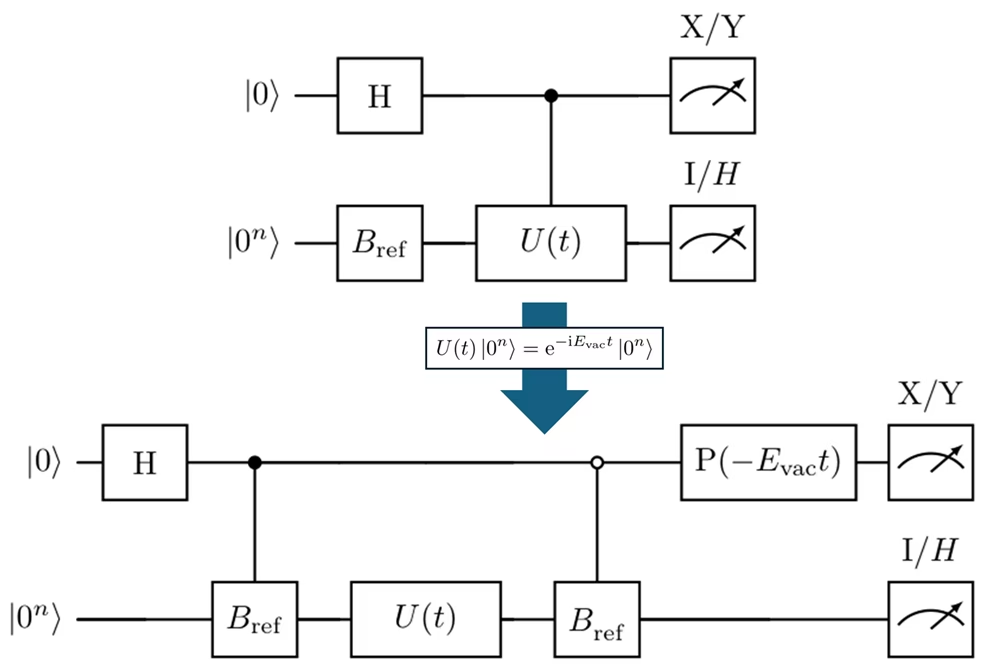
כאן, מכין את מצב הייחוס, .
במקום להכין תחילה את ולאחר מכן להפעיל רק על ענף , המעגל מכין ישירות את שני הענפים כך
where
המעגל מפעיל תחילה שער Hadamard על העזר ומכין את מצב הייחוס רק על ענף :
לאחר מכן מפעילים את אופרטור אבולוציית הזמן הלא-מבוקר על שני הענפים:
מכיוון שההמילטוניאן משמר את מספר העירור, אנחנו יכולים לראות ש- הוא מצב עצמי שלו, ולכן אופרטור האבולוציה רק צובר פאזה תחת ההמילטוניאן:
Therefore,
לאחר מכן, מופעל רק על ענף .
בשלב זה, לשני הענפים יש פאזה יחסית נוספת. כדי להסיר אותה, אנחנו מפעילים את שער הפאזה של העזר
זה משנה את המצב ל-
לכן, עד לפאזה גלובלית לא רלוונטית, הכנו לבסוף
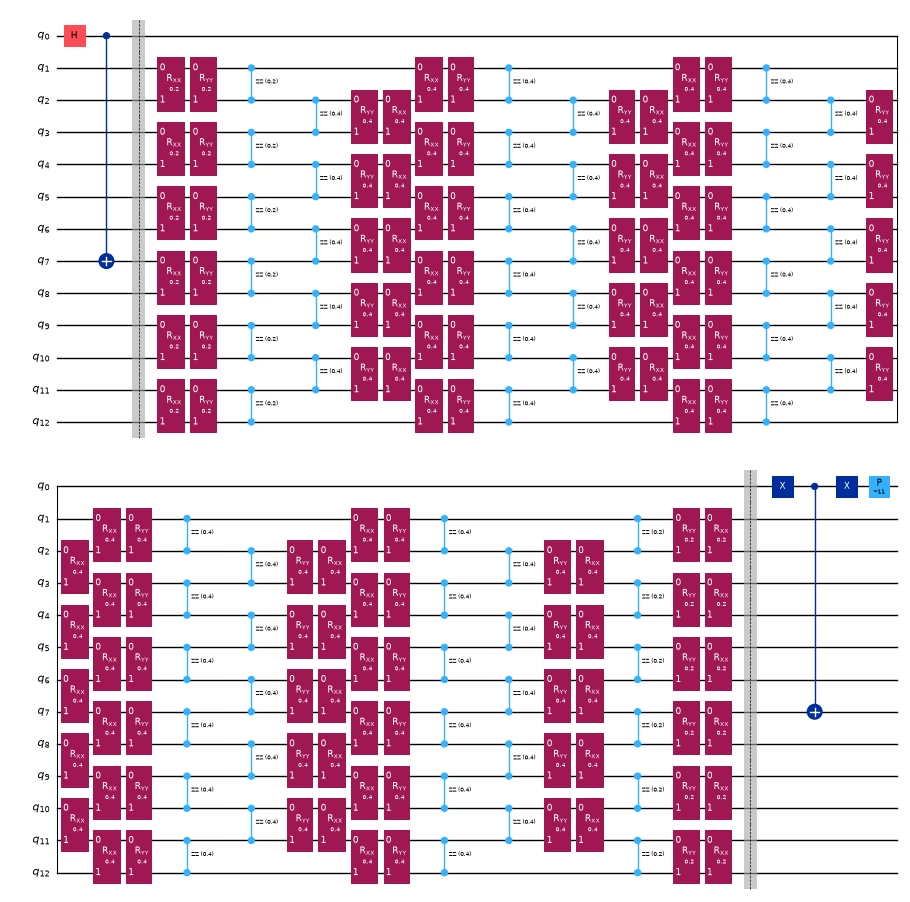
בבלוק הקוד הבא, אנחנו מיישמים את המעגל החופשי-משליטה הזה.
controlled_extended_swap_test = extended_swap_test

# Reuse the ordering and synthesis rule selected by the comparison above.
evol_gate_optimized = PauliEvolutionGate(
    hamiltonian_for_synthesis,
    time=t,
    synthesis=SuzukiTrotter(order=2, reps=num_trotter_steps),
)

uncontrolled_evolution = QuantumCircuit(num_qubits, name="U_ST2(t)")
uncontrolled_evolution.append(evol_gate_optimized, range(num_qubits))

controlled_state_prep = QuantumCircuit(num_qubits + 1, name="C-Prep")
for q, bit in enumerate(reversed(ref_bitstring)):
    if bit == "1":
        controlled_state_prep.cx(ancilla, system_qubits[q])

vacuum_bitstring = "0" * num_qubits
vacuum_energy = basis_state_expectation_sparse(hamiltonian, "0" * num_qubits)

optimized_extended_swap_test = QuantumCircuit(num_qubits + 1)
optimized_extended_swap_test.h(ancilla)

# Prepare |psi_ref> only on the |1> branch.
optimized_extended_swap_test.compose(controlled_state_prep, inplace=True)
optimized_extended_swap_test.barrier()

# Apply the Trotterized time evolution without control.
optimized_extended_swap_test.compose(
    uncontrolled_evolution,
    qubits=system_qubits,
    inplace=True,
)
optimized_extended_swap_test.barrier()

# Map |0>|0...0> to |0>|psi_ref>, leaving the |1> branch unchanged.
optimized_extended_swap_test.x(ancilla)
optimized_extended_swap_test.compose(controlled_state_prep, inplace=True)
optimized_extended_swap_test.x(ancilla)

# Cancel the known vacuum phase so that the same X/Y observables can be used.
optimized_extended_swap_test.p(-vacuum_energy * t, ancilla)
optimized_extended_swap_test = simple_transpilation(
    optimized_extended_swap_test
)

print(f"Vacuum energy E_vac = {vacuum_energy:.1f}")
display(
    optimized_extended_swap_test.assign_parameters({t: 1.0}).draw(
        "mpl", scale=0.5, fold=26
    )
)
Vacuum energy E_vac = 11.0+0.0j
Transpilation
עכשיו, אנחנו מבצעים transpile למעגלים המבוקר והחופשי-משליטה כך שיהיו ניתנים להרצה על החומרה. בואו נשווה את התוצאה של המעגלים אחרי ה-transpile.
pass_manager = generate_preset_pass_manager(
    backend=backend,
    optimization_level=3,
)

isa_controlled_extended_swap_test = pass_manager.run(
    controlled_extended_swap_test
)

pass_manager = generate_preset_pass_manager(
    backend=backend, optimization_level=3, routing_method="none"
)
isa_optimized_extended_swap_test = pass_manager.run(
    optimized_extended_swap_test
)

transpilation_result = [
    {
        "label": "abstract controlled U(t)",
        **summarize_circuit(isa_controlled_extended_swap_test),
    },
    {
        "label": "optimized non-controlled U(t)",
        **summarize_circuit(isa_optimized_extended_swap_test),
    },
]

display(pd.DataFrame(transpilation_result))

def filter_qubits_from_layout(layout):
    q_layout = Layout(
        {
            physical: virtual
            for physical, virtual in layout.get_physical_bits().items()
            if virtual._register.name == "q"
        }
    )
    return q_layout

print(
    filter_qubits_from_layout(
        isa_optimized_extended_swap_test.layout.initial_layout
    )
)

isa_observables = [
    op.apply_layout(isa_optimized_extended_swap_test.layout)
    for op in observables
]
label  depth   size  2q gates  2q depth
0       abstract controlled U(t)  15457  23786      4686      4580
1  optimized non-controlled U(t)    261   1716       307        57
Layout({
18: <Qubit register=(13, "q"), index=0>,
5: <Qubit register=(13, "q"), index=1>,
6: <Qubit register=(13, "q"), index=2>,
7: <Qubit register=(13, "q"), index=3>,
8: <Qubit register=(13, "q"), index=4>,
9: <Qubit register=(13, "q"), index=5>,
10: <Qubit register=(13, "q"), index=6>,
11: <Qubit register=(13, "q"), index=7>,
12: <Qubit register=(13, "q"), index=8>,
13: <Qubit register=(13, "q"), index=9>,
14: <Qubit register=(13, "q"), index=10>,
15: <Qubit register=(13, "q"), index=11>,
19: <Qubit register=(13, "q"), index=12>
})
שלב 3: ביצוע באמצעות פרימיטיבים של Qiskit
השלב הבא הוא לשלוח את אותו מעגל פרמטרי עבור כמה ערכים של . עבור כל , אנחנו מעריכים ארבעה ערכי תוחלת: , , , ו-. ארבעת המספרים האלה משולבים לאחר מכן לאיברי השורה הראשונה המרוכבים ו-.
כאן, ו- ניתנים לחישוב קלאסי מכיוון ש- דליל, ולכן אנחנו מדלגים על מקרה .
pub_list = []
d_values = list(range(1, krylov_dim))

# Exact local statevector estimator.
estimator = StatevectorEstimator()

# We use the circuit before the transpilation for the local simulator,
# but we will use the transpiled circuit for the real backend.
for d in d_values:
    parameter_values = [d * dt]

    for ob in observables:
        pub_list.append(
            (
                optimized_extended_swap_test,
                ob,
                parameter_values,
            )
        )

job = estimator.run(pub_list)

# Local PrimitiveJob does not provide Runtime-style job inputs,
# so preserve the inputs directly.
inputs = pub_list
result = job.result()

print(f"Number of Krylov basis states: r = {len(d_values)}")
print(f"Number of PUBs: {len(pub_list)}")
print(f"Each d uses observables: {observable_labels}")
Number of Krylov basis states: r = 9
Number of PUBs: 36
Each d uses observables: ['Re S_0d', 'Im S_0d', 'Re shifted H_0d', 'Im shifted H_0d']
שלב 4: עיבוד לאחר והחזרת תוצאה בפורמט קלאסי רצוי
לאחר הערכת המטריצות המוקרנות, אנחנו מבצעים רגולריזציה ופותרים את ה-GEVP
הערך העצמי המוכלל הקטן ביותר נותן את הערכת KQD לאנרגיית מצב היסוד.
h_shifted_row_est = np.zeros(krylov_dim, dtype=complex)
s_row_est = np.zeros(krylov_dim, dtype=complex)

h_shifted_row_est[0] = ref_energy - shift_tau
s_row_est[0] = 1.0

for idx, (pub_input, pub_result) in enumerate(zip(inputs, result)):
    d_index, obs_index = divmod(idx, len(observables))
    ev = np.asarray(pub_result.data.evs).reshape(-1)[0]
    std = np.asarray(pub_result.data.stds).reshape(-1)[0]

    if obs_index == 0:
        s_row_est[d_index + 1] = ev
    elif obs_index == 1:
        s_row_est[d_index + 1] += 1j * ev
    elif obs_index == 2:
        h_shifted_row_est[d_index + 1] = ev
    elif obs_index == 3:
        h_shifted_row_est[d_index + 1] += 1j * ev

# H_0d = shifted_H_0d + tau * S_0d.
h_row_est = h_shifted_row_est + shift_tau * s_row_est

h_matrix_est = la.toeplitz(h_row_est.conj(), h_row_est)
s_matrix_est = la.toeplitz(s_row_est.conj(), s_row_est)

s_eigvals = la.eigvalsh(0.5 * (s_matrix_est + s_matrix_est.conj().T))
positive_s_eigvals = s_eigvals[s_eigvals > 1e-12]
s_condition_number = (
    positive_s_eigvals[-1] / positive_s_eigvals[0]
    if len(positive_s_eigvals) > 0
    else np.inf
)

with np.printoptions(precision=3, suppress=True):
    print("Estimated first row of S:")
    print(s_row_est)
    print()
    print("Estimated first row of H:")
    print(h_row_est)
    print()
    print("Eigenvalues of the estimated overlap matrix S:")
    print(s_eigvals)
    print(f"Condition number above 1e-12: {s_condition_number:.3e}")
    print()
Estimated first row of S:
[ 1.   +0.j     0.758-0.596j  0.203-0.836j -0.291-0.636j -0.444-0.229j
 -0.276+0.053j -0.044+0.051j  0.006-0.121j -0.155-0.218j -0.345-0.101j]

Estimated first row of H:
[ 7.   +0.j     4.842-4.76j   0.044-6.185j -3.791-3.653j -4.137+0.39j
 -1.495+2.654j  1.331+1.777j  1.85 -0.763j -0.032-2.278j -2.222-1.372j]

Eigenvalues of the estimated overlap matrix S:
[-0.     0.     0.     0.     0.     0.     0.01   0.355  3.526  6.109]
Condition number above 1e-12: 1.904e+12
עכשיו אנחנו פותרים את בעיית הערכים העצמיים המוכללת באמצעות המטריצות שנבנו מהערכות המעגל. בחישוב מצב-וקטור אידיאלי עם אבולוציית זמן-אמת מדויקת, זה אמור לשחזר את התוצאה המוקרנת המדויקת. בפועל, סטיות יכולות לנבוע מ-Trotterization, שגיאת דגימה, ואי-יציבות נומרית של מטריצת החפיפה.
אנחנו עוקבים איך האנרגיה מתכנסת ככל שאנחנו מגדילים את הממד של תת-המרחב של קרילוב.
exact_evals = diagonalize_single_1_subspace(hamiltonian)
exact_ground = min(exact_evals)
print("exact ground state energy:  ", exact_ground)

threshold = 1e-12
energy_convergence = []

for r in range(1, krylov_dim + 1):
    energy_est_kqd, coeffs_est, retained_est = solve_thresholded_gevp(
        h_matrix_est[:r, :r],
        s_matrix_est[:r, :r],
        threshold=threshold,
    )
    energy_convergence.append(energy_est_kqd)
    print(
        f"Krylov ground state energy (dim={r}, retained={retained_est}): ",
        energy_est_kqd,
    )
exact ground state energy:   3.136296694843727
Krylov ground state energy (dim=1, retained=1):  7.0
Krylov ground state energy (dim=2, retained=2):  4.184510657551266
Krylov ground state energy (dim=3, retained=3):  3.5539074630394136
Krylov ground state energy (dim=4, retained=4):  3.3366270761341044
Krylov ground state energy (dim=5, retained=5):  3.252017453225087
Krylov ground state energy (dim=6, retained=6):  3.2300275138879186
Krylov ground state energy (dim=7, retained=7):  3.2299154099085685
Krylov ground state energy (dim=8, retained=7):  3.2298063744216776
Krylov ground state energy (dim=9, retained=7):  3.2296778282872456
Krylov ground state energy (dim=10, retained=8):  3.223647515867734
def plot_energy_convergence(energy_convergence, exact_ground, krylov_dim):
    fig, ax = plt.subplots(figsize=(7, 4.5))

    ax.plot(
        range(1, krylov_dim + 1),
        energy_convergence,
        marker="o",
        label="KQD estimate",
    )

    ax.axhline(
        exact_ground,
        linestyle="--",
        label=f"Exact ground energy = {exact_ground:.6f}",
    )

    ax.set_xlabel("Krylov dimension")
    ax.set_ylabel("Ground-state energy")
    ax.grid(True, alpha=0.3)
    ax.legend()
    plt.tight_layout()
    plt.show()

plot_energy_convergence(energy_convergence, exact_ground, krylov_dim)

דוגמת חומרה בקנה מידה גדול
הסעיף הקודם השתמש במודל של 12 קיוביטים כך שניתן היה להשתמש בסימולציית מצב-וקטור ככלי אבחון. עכשיו אנחנו מרחיבים את אותו זרימת עבודה של KQD לשרשרת הייזנברג בת 30 קיוביטים ומכינים את העומס להרצה על חומרת IBM Quantum.
שלבים 1-4 מכווצים לבלוק קוד יחיד
כאן אנחנו מרכיבים עכשיו את כל הפרטים האלה לזרימת עבודה אחת בקנה מידה גדול יותר, שרצה לאחר מכן על חומרת הקוונטים האמיתית שלנו. בסעיף זה, אנחנו מיישמים הגדרות ריאליסטיות של הפחתת שגיאות כדי לשפר את אמינות התוצאות. מכיוון שניתן להעריך את איברי המטריצה המתאימים לערכים שונים של במקביל, אנחנו משתמשים במצב Batch כדי להריץ אותם ביעילות.
# -------------------------Step 1-------------------------

# Map the classical problem to quantum circuits and observables.
# Problem and KQD parameters.
large_num_qubits = 30
large_krylov_dim = 7
large_num_trotter_steps = 3
large_dt = np.pi / (3 * (large_num_qubits - 1))
large_t = Parameter("t_large")

# Use a single excitation near the center of the chain.
large_excitation_qubit = large_num_qubits // 2
large_ref_label = ["0"] * large_num_qubits
large_ref_label[large_num_qubits - 1 - large_excitation_qubit] = "1"
large_ref_bitstring = "".join(large_ref_label)

# Use the ordering and product formula selected in the preceding section.
large_hamiltonian = make_heisenberg_hamiltonian_ordered(
    large_num_qubits,
    ordering="even-odd edge-grouped",
    coupling=1.0,
)
large_ref_energy = float(
    np.real(
        basis_state_expectation_sparse(large_hamiltonian, large_ref_bitstring)
    )
)
large_vacuum_energy = float(
    np.real(
        basis_state_expectation_sparse(
            large_hamiltonian, "0" * large_num_qubits
        )
    )
)

large_evolution_gate = PauliEvolutionGate(
    large_hamiltonian,
    time=large_t,
    synthesis=SuzukiTrotter(order=2, reps=large_num_trotter_steps),
)
large_uncontrolled_evolution = QuantumCircuit(
    large_num_qubits,
    name="U_ST2_large(t)",
)
large_uncontrolled_evolution.append(
    large_evolution_gate,
    range(large_num_qubits),
)

# Build the control-free extended-swap-test circuit.
large_ancilla = 0
large_system_qubits = list(range(1, large_num_qubits + 1))

large_controlled_state_prep = QuantumCircuit(
    large_num_qubits + 1,
    name="C-Prep-large",
)
large_controlled_state_prep.cx(
    large_ancilla,
    large_system_qubits[large_excitation_qubit],
)

large_extended_swap_test = QuantumCircuit(large_num_qubits + 1)
large_extended_swap_test.h(large_ancilla)
large_extended_swap_test.compose(large_controlled_state_prep, inplace=True)
large_extended_swap_test.compose(
    large_uncontrolled_evolution,
    qubits=large_system_qubits,
    inplace=True,
)
large_extended_swap_test.x(large_ancilla)
large_extended_swap_test.compose(
    large_controlled_state_prep.inverse(),
    inplace=True,
)
large_extended_swap_test.x(large_ancilla)
large_extended_swap_test.p(
    -large_vacuum_energy * large_t,
    large_ancilla,
)

# Reuse the Hamiltonian-shifting construction from the preceding section.
(
    large_obs_x_shifted_hamiltonian,
    large_obs_y_shifted_hamiltonian,
    large_shift_tau,
) = make_reduced_heisenberg_observables(large_ref_bitstring)

large_observables = [
    SparsePauliOp("I" * large_num_qubits + "X"),
    SparsePauliOp("I" * large_num_qubits + "Y"),
    large_obs_x_shifted_hamiltonian,
    large_obs_y_shifted_hamiltonian,
]
large_observable_labels = [
    "Re S_0d",
    "Im S_0d",
    "Re shifted H_0d",
    "Im shifted H_0d",
]

# -------------------------Step 2-------------------------

# Optimize the problem for quantum execution.
# Select a real backend and transpile the parameterized circuit to ISA form.
large_backend = service.backend("ibm_boston")
large_pass_manager = generate_preset_pass_manager(
    backend=large_backend, optimization_level=3, routing_method="none"
)
large_isa_circuit = large_pass_manager.run(large_extended_swap_test)
large_isa_observables = [
    observable.apply_layout(large_isa_circuit.layout)
    for observable in large_observables
]

large_two_qubit_gate_count = sum(
    instruction.operation.num_qubits == 2
    for instruction in large_isa_circuit.data
)

print(f"Backend: {large_backend.name}")
print(f"System qubits: {large_num_qubits}")
print(f"Total circuit qubits: {large_isa_circuit.num_qubits}")
print(f"Krylov dimension: {large_krylov_dim}")
print(f"Time step: {large_dt:.6f}")
print(f"Shift tau: {large_shift_tau}")
print(f"ISA circuit depth: {large_isa_circuit.depth()}")
print(f"ISA two-qubit gates: {large_two_qubit_gate_count}")
print(
    f"ISA two-qubit depth: {large_isa_circuit.depth(lambda x: x[0].num_qubits == 2)}"
)

# -------------------------Step 3-------------------------

# Execute on quantum hardware with Qiskit Runtime primitives.
# Submit one job per d, with all four observables in that job.
large_d_values = list(range(1, large_krylov_dim))
retrieve_batch_id = None
large_jobs = []

if retrieve_batch_id is None:
    large_estimator_options = {
        "default_shots": 8192,
        "dynamical_decoupling": {
            "enable": True,
            "sequence_type": "XpXm",
        },
        "resilience": {
            "measure_mitigation": True,
            "measure_noise_learning": {
                "num_randomizations": 32,
                "shots_per_randomization": 256,
            },
            "layer_noise_learning": {
                "max_layers_to_learn": 4,
                "layer_pair_depths": [0, 1, 2, 4, 16, 32],
                "num_randomizations": 32,
                "shots_per_randomization": 128,
            },
            "zne_mitigation": True,
            "zne": {
                "amplifier": "pea",
                "noise_factors": [1.0, 1.5, 2.0],
                "extrapolator": ("exponential", "linear"),
            },
        },
        "twirling": {
            "enable_gates": True,
            "enable_measure": True,
            "num_randomizations": 32,
            "shots_per_randomization": 256,
            "strategy": "active-accum",
        },
    }

    with Batch(backend=large_backend) as large_batch:
        large_batch_id = large_batch.session_id
        large_estimator = EstimatorV2(
            mode=large_batch,
            options=large_estimator_options,
        )
        # Krylov quantum diagonalization of lattice Hamiltonians -> TUT_KQDOLH.
        large_estimator.options.environment.job_tags = ["TUT_KQDOLH"]

        for d in large_d_values:
            parameter_values = [d * large_dt]
            pubs_for_d = [
                (large_isa_circuit, observable, parameter_values)
                for observable in large_isa_observables
            ]
            job = large_estimator.run(pubs_for_d)
            large_jobs.append(job)
            print(
                f"Submitted d={d}: job_id={job.job_id()}, "
                f"PUBs={len(pubs_for_d)}"
            )

    print(f"Batch ID: {large_batch_id}")
else:
    large_batch_id = retrieve_batch_id
    large_jobs = service.jobs(
        session_id=large_batch_id,
        limit=None,
        descending=False,
    )

large_job_ids_by_d = {
    d: job.job_id() for d, job in zip(large_d_values, large_jobs)
}
print(f"Job IDs by d: {large_job_ids_by_d}")

# -------------------------Step 4-------------------------

# Post-process the quantum results and solve the classical GEVP.
# Reconstruct the first rows of S and the shifted Hamiltonian matrix.
large_s_row_est = np.zeros(large_krylov_dim, dtype=complex)
large_h_shifted_row_est = np.zeros(large_krylov_dim, dtype=complex)
large_s_row_est[0] = 1.0
large_h_shifted_row_est[0] = large_ref_energy - large_shift_tau

for d, job in zip(large_d_values, large_jobs):
    job_result = job.result()

    if len(job_result) != len(large_observables):
        raise RuntimeError(
            f"Expected {len(large_observables)} PUB results for d={d}, "
            f"but received {len(job_result)}."
        )

    expectation_values = [
        np.asarray(pub_result.data.evs).reshape(-1)[0]
        for pub_result in job_result
    ]

    large_s_row_est[d] = expectation_values[0] + 1j * expectation_values[1]
    large_h_shifted_row_est[d] = (
        expectation_values[2] + 1j * expectation_values[3]
    )

# H_0d = shifted_H_0d + tau * S_0d.
large_h_row_est = large_h_shifted_row_est + large_shift_tau * large_s_row_est

large_s_matrix_est = la.toeplitz(
    large_s_row_est.conj(),
    large_s_row_est,
)
large_h_matrix_est = la.toeplitz(
    large_h_row_est.conj(),
    large_h_row_est,
)

large_exact_gnd = min(diagonalize_single_1_subspace(large_hamiltonian))

large_energy_convergence = []

with np.printoptions(precision=5, suppress=True):
    print("Estimated first row of S:")
    print(large_s_row_est)
    print("Estimated first row of H:")
    print(large_h_row_est)
    print("exact ground state energy:  ", large_exact_gnd)

    for r in range(1, large_krylov_dim + 1):
        energy_est_kqd, coeffs_est, retained_est = solve_thresholded_gevp(
            large_h_matrix_est[:r, :r],
            large_s_matrix_est[:r, :r],
            threshold=5e-2,
        )
        large_energy_convergence.append(energy_est_kqd)
        print(
            f"Krylov ground state energy (dim={r}, retained={retained_est}): ",
            energy_est_kqd,
        )

plot_energy_convergence(
    large_energy_convergence, large_exact_gnd, large_krylov_dim
)
Backend: ibm_boston
System qubits: 30
Total circuit qubits: 156
Krylov dimension: 7
Time step: 0.036110
Shift tau: 25.0
ISA circuit depth: 219
ISA two-qubit gates: 728
ISA two-qubit depth: 52
Job IDs by d: {1: 'd9fl4p4jeosc73fk4dg0', 2: 'd9fl4pineu4c739poecg', 3: 'd9fl4q2neu4c739poedg', 4: 'd9fl4qhhtsac739fjgn0', 5: 'd9fl4r4jeosc73fk4dhg', 6: 'd9fl4rkjeosc73fk4dj0'}
Estimated first row of S:
[ 1.     +0.j       0.42055-0.65466j -0.17883-0.73125j -0.64523-0.31601j
 -0.70781+0.55574j -0.02467+0.70525j  0.59301+0.55602j]
Estimated first row of H:
[ 25.      +0.j       10.3419 -16.5586j   -5.017  -18.03933j
 -16.44797 -6.98173j -17.17081+14.84502j   0.62722+17.81196j
  15.68886+12.74875j]
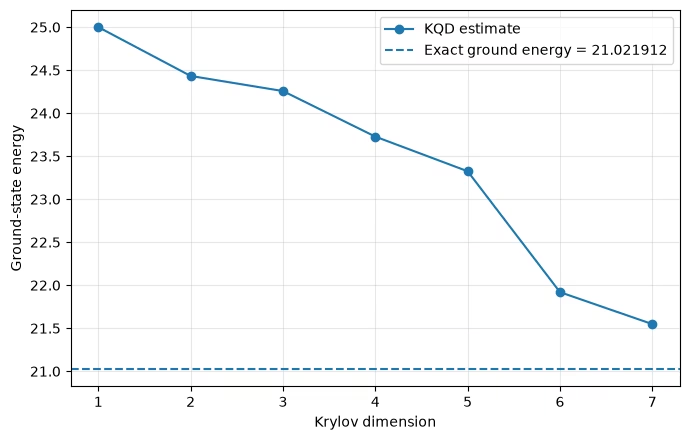
exact ground state energy:   21.021912418526902
Krylov ground state energy (dim=1, retained=1):  25.0
Krylov ground state energy (dim=2, retained=2):  24.432409110686205
Krylov ground state energy (dim=3, retained=3):  24.256856893278556
Krylov ground state energy (dim=4, retained=4):  23.727409826799715
Krylov ground state energy (dim=5, retained=4):  23.324720470780864
Krylov ground state energy (dim=6, retained=5):  21.91957579005085
Krylov ground state energy (dim=7, retained=5):  21.548331214122644
נספח: נקודת המבט של פונקציית-ההמילטוניאן (מסנן-ספקטרלי)
זרימת העבודה העיקרית הציגה את KQD באופן אופרטיבי: לבנות בסיס קרילוב ממצבים שעברו אבולוציית זמן-אמת, להעריך את המטריצות המוקרנות ו-, ולפתור את ה-GEVP. הנספח הזה חוזר אל אותו חישוב מזווית משלימה שמסבירה מדוע KQD עובד: נקודת המבט של פונקציית-ההמילטוניאן, או מסנן-ספקטרלי [3], [5]. הוא משתמש שוב במודל בן 12 הקיוביטים, בצעד הזמן , ובפתרון קרילוב שכבר התקבל למעלה; לא נדרשת הרצת מעגל חדשה.
מצב הייחוס כהתפלגות אנרגיה
נניח שלהמילטוניאן יש את הפירוק העצמי
עם מצבים עצמיים של אנרגיה . כל מצב ייחוס אפשר להרחיב בבסיס העצמי הזה,
כך שהוא נושא משקל ספקטרלי בכל אנרגיה . אנרגיית הייחוס היא הממוצע של ההתפלגות הזו, .
הפירוק העצמי של המילטוניאן כללי בן קיוביטים יקר באופן אקספוננציאלי, כך שתמונה זו היא רק כלי אבחון, שהוא לא חלק מהאלגוריתם. כאן, לעומת זאת, אנחנו יכולים לחשב אותה בזול עבור אותה בעיה עם : המילטוניאן הייזנברג משמר את מספר העירור הכולל, ומצב הייחוס נושא עירור בודד, כך שכל התוכן הספקטרלי שלו חי בתת-המרחב של עירור בודד שהממד שלו גדל באופן ליניארי בלבד עם . לכן אנחנו משתמשים שוב בבלוק העירור-הבודד המדויק (שכבר שימש למעלה כמדד השוואה) וקוראים את התפלגות הייחוס בתוך תת-המרחב הזה.
# Exact single-excitation-subspace decomposition of the reference state.
# This reuses make_heisenberg_hamiltonian / _basis_state_transition_amplitude_sparse
# and the n=12 `hamiltonian` and `ref_bitstring` defined in the small-scale example.
single_excitation_states = [1 << k for k in range(num_qubits)]

h_single = np.array(
    [
        [
            _basis_state_transition_amplitude_sparse(hamiltonian, bra, ket)
            for ket in single_excitation_states
        ]
        for bra in single_excitation_states
    ]
)
h_single = 0.5 * (h_single + h_single.conj().T)

subspace_evals, subspace_evecs = la.eigh(h_single)
subspace_evals = np.real(subspace_evals)

# Reference-state coordinates inside the single-excitation subspace.
ref_position = single_excitation_states.index(int(ref_bitstring, 2))
ref_in_subspace = np.zeros(num_qubits, dtype=complex)
ref_in_subspace[ref_position] = 1.0

# Amplitudes and spectral weights of the reference in the energy eigenbasis.
ref_eigen_amplitudes = subspace_evecs.conj().T @ ref_in_subspace
ref_spectral_weights = np.abs(ref_eigen_amplitudes) ** 2

print(f"Single-excitation subspace dimension: {num_qubits}")
print(f"Subspace ground-state energy:         {subspace_evals[0]:.6f}")
print(
    f"Reference energy (sum p_m E_m):       {np.sum(ref_spectral_weights * subspace_evals):.6f}"
)
print(f"Reference weight on subspace ground:  {ref_spectral_weights[0]:.6f}")
Single-excitation subspace dimension: 12
Subspace ground-state energy:         3.136297
Reference energy (sum p_m E_m):       7.000000
Reference weight on subspace ground:  0.163827
KQD לומד מסנן שמעצב מחדש את ההתפלגות הזו
פונקציית המילטוניאן מוגדרת דרך חשבון ספקטרלי,
או במילים אחרות, סכום משוקלל של מקרינים עצמיים. הפעלתה על הייחוס מעצבת מחדש כל אמפליטודה ספקטרלית, :
אילו הייתה ממוקדת בחדות באנרגיה הנמוכה ביותר ( ו- אחרת) אז הייתה פועלת כמקרין מצב-יסוד, והפלט המנורמל היה (קרוב ל)מצב היסוד. לכן, מסנן ספקטרלי תת-מעבירי טוב באנרגיה הוא בדיוק מה שאנחנו רוצים.
KQD לא קובע מראש את . במקום זאת הוא מרחיב את המסנן בבסיס אבולוציית זמן-האמת,
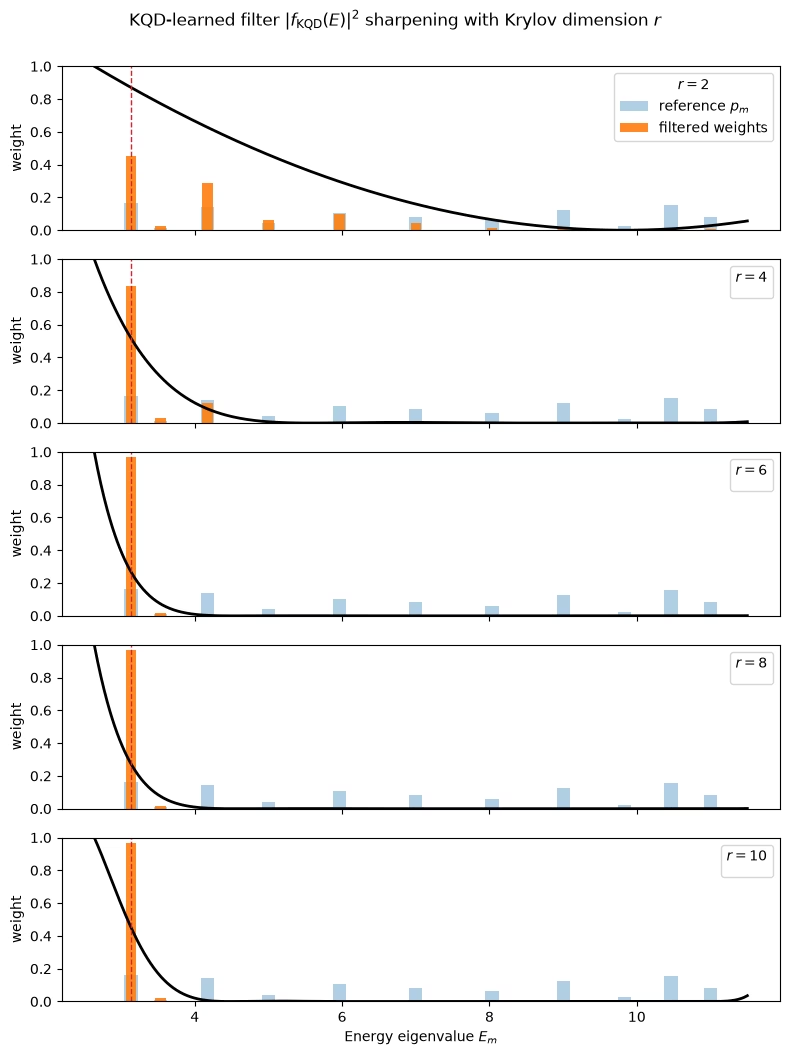
פונקציה טריגונומטרית של האנרגיה שהמקדמים שלה הם בדיוק וקטור העצמי של ה-GEVP שנפתר למעלה. מזעור מנת Rayleigh הוא לכן זהה ללמידת המסנן שמדכא בצורה הטובה ביותר את המשקל של המצב הנרגש בייחוס. ממד קרילוב גדול יותר נותן למסנן יותר דרגות חופש ופסגה חדה יותר באנרגיית מצב היסוד.
הפונקציה העזר להלן מעריכה את המסנן הנלמד הזה על ציר אנרגיה; אנחנו מיישמים אותו לאחר מכן על התפלגות הייחוס שהתקבלה למעלה.
def trigonometric_krylov_filter(
    coeffs: np.ndarray,
    energies: np.ndarray,
    time_step: float,
) -> np.ndarray:
    """Evaluate the learned Krylov filter f(E) = sum_l c_l exp(-i l dt E)."""
    values = np.zeros_like(energies, dtype=complex)
    for ell, coeff in enumerate(coeffs):
        values += coeff * np.exp(-1j * ell * time_step * energies)
    return values

def filtered_spectral_weights(
    weights: np.ndarray,
    filter_values: np.ndarray,
) -> np.ndarray:
    """Reshape spectral weights by |f(E)|^2 and renormalize."""
    reshaped = weights * np.abs(filter_values) ** 2
    return reshaped / np.sum(reshaped)

# Recover the KQD coefficients from the already-estimated projected matrices.
# The shift only moves H by tau * S, so it does not change the GEVP eigenvector;
# we solve at the full Krylov dimension used in the small-scale example.
_, kqd_coeffs, _ = solve_thresholded_gevp(
    h_matrix_est,
    s_matrix_est,
    threshold=1e-12,
)

filter_on_spectrum = trigonometric_krylov_filter(
    kqd_coeffs, subspace_evals, dt
)
filtered_weights = filtered_spectral_weights(
    ref_spectral_weights, filter_on_spectrum
)

print(f"Ground-state overlap  (reference): {ref_spectral_weights[0]:.4f}")
print(f"Ground-state overlap  (filtered):  {filtered_weights[0]:.4f}")
print(
    f"Mean energy           (reference): {np.sum(ref_spectral_weights * subspace_evals):.6f}"
)
print(
    f"Mean energy           (filtered):  {np.sum(filtered_weights * subspace_evals):.6f}"
)
Ground-state overlap  (reference): 0.1638
Ground-state overlap  (filtered):  0.9638
Mean energy           (reference): 7.000000
Mean energy           (filtered):  3.164503
הדמיה של המסנן והגמישות שלו
אנחנו מציגים תחילה את המסנן הנלמד בממד קרילוב המלא שהיה בשימוש למעלה, ולאחר מכן עוקבים איך הוא מתחדד ככל שהממד גדל.
העמודות מציגות את המשקלים הספקטרליים של הייחוס (לפני) ואת המשקלים המסוננים (אחרי), יחד עם עוצמת המסנן הנלמד על ציר אנרגיה רציף. המסנן מרכז את המשקל על האנרגיה הנמוכה ביותר של תת-המרחב של עירור-בודד — אותה אנרגיה שאליה התכנסה הערכת KQD בדוגמה בקנה מידה קטן. שימו לב שזהו מצב היסוד בתוך המגזר של עירור-בודד, שהוא היעד הרלוונטי למצב הייחוס המשמר-עירור הזה, ולא מצב היסוד הגלובלי.
fig, ax = plt.subplots(figsize=(8, 4))

visible = (ref_spectral_weights > 1e-4) | (filtered_weights > 1e-4)
ax.bar(
    subspace_evals[visible],
    ref_spectral_weights[visible],
    width=0.18,
    alpha=0.45,
    label="reference $p_m$",
)
ax.bar(
    subspace_evals[visible],
    filtered_weights[visible],
    width=0.14,
    alpha=0.9,
    label=r"filtered $p_m\,|f_{\rm KQD}(E_m)|^2$",
)

energy_grid = np.linspace(
    subspace_evals.min() - 0.5, subspace_evals.max() + 0.5, 800
)
filter_intensity = (
    np.abs(trigonometric_krylov_filter(kqd_coeffs, energy_grid, dt)) ** 2
)
filter_intensity /= filter_intensity.max()
ax.plot(
    energy_grid,
    filter_intensity,
    color="k",
    linewidth=2,
    label=r"$|f_{\rm KQD}(E)|^2$ (normalized)",
)

ax.axvline(
    subspace_evals[0],
    color="C3",
    linestyle="--",
    linewidth=1,
    label="subspace ground energy",
)
ax.set_xlabel("Energy eigenvalue $E_m$")
ax.set_ylabel("Spectral weight")
ax.set_ylim(0, 1)
ax.legend(loc="upper right")
plt.tight_layout()
plt.show()

הגדלת ממד קרילוב: גמישות הפונקציה הנלמדת
נזכיר שהמסנן הנלמד הוא פולינום טריגונומטרי באנרגיה עם מקדמים,
ממד קרילוב הוא בדיוק מספר המקדמים החופשיים, ולכן הוא שולט בגמישות של הפונקציה. קטן יכול לייצר רק מסנן רחב ומשתנה בעדינות שדולף משקל למצבים נרגשים נמוכים; כאשר גדל, המסנן יכול ליצור פסגה צרה יותר באנרגיית היעד ולדכא את משקל המצב הנרגש הנותר בצורה אגרסיבית יותר. זהו המקבילה של מסנן-ספקטרלי להתכנסות האנרגיה שנצפתה בדוגמה בקנה מידה קטן: ככל ש- גדל, ההתפלגות המסוננת קורסת לתוך מצב היסוד של תת-המרחב והאנרגיה המוערכת יורדת לעברו.
אנחנו משתמשים שוב במטריצות המוקרנות שכבר הוערכו למעלה ופשוט פותרים את ה-GEVP בכל בלוק מוביל, ולאחר מכן מעריכים ומציירים את המסנן המתאים.
# Sweep the Krylov dimension using the leading r x r blocks of the estimated matrices.
sweep_dims = [r for r in (2, 4, 6, 8, krylov_dim) if r <= krylov_dim]
sweep_dims = sorted(set(sweep_dims))

energy_grid = np.linspace(
    subspace_evals.min() - 0.5, subspace_evals.max() + 0.5, 800
)

sweep_cases = []
print(" r    retained    ground overlap    filtered energy")
print("--    --------    --------------    ---------------")
for r in sweep_dims:
    _, coeffs_r, retained_r = solve_thresholded_gevp(
        h_matrix_est[:r, :r],
        s_matrix_est[:r, :r],
        threshold=1e-12,
    )
    filter_on_spectrum_r = trigonometric_krylov_filter(
        coeffs_r, subspace_evals, dt
    )
    filtered_weights_r = filtered_spectral_weights(
        ref_spectral_weights, filter_on_spectrum_r
    )
    filtered_energy_r = float(np.sum(filtered_weights_r * subspace_evals))

    sweep_cases.append((r, coeffs_r, filtered_weights_r))
    print(
        f"{r:2d}    {retained_r:8d}    {filtered_weights_r[0]:14.4f}    {filtered_energy_r:15.6f}"
    )

print(f"\nSubspace ground-state energy (target): {subspace_evals[0]:.6f}")

# One panel per Krylov dimension: filtered spectrum (bars) + filter intensity (curve).
fig, axes = plt.subplots(
    len(sweep_cases),
    1,
    figsize=(8, 2.1 * len(sweep_cases)),
    sharex=True,
)
axes = np.atleast_1d(axes)

for idx, (ax, (r, coeffs_r, filtered_weights_r)) in enumerate(
    zip(axes, sweep_cases)
):
    visible = (ref_spectral_weights > 1e-4) | (filtered_weights_r > 1e-4)
    ax.bar(
        subspace_evals[visible],
        ref_spectral_weights[visible],
        width=0.18,
        alpha=0.35,
        color="C0",
        label="reference $p_m$" if idx == 0 else None,
    )
    ax.bar(
        subspace_evals[visible],
        filtered_weights_r[visible],
        width=0.14,
        alpha=0.9,
        color="C1",
        label="filtered weights" if idx == 0 else None,
    )

    filter_intensity_r = (
        np.abs(trigonometric_krylov_filter(coeffs_r, energy_grid, dt)) ** 2
    )
    filter_intensity_r /= filter_intensity_r.max()
    ax.plot(energy_grid, filter_intensity_r, color="k", linewidth=2)

    ax.axvline(subspace_evals[0], color="C3", linestyle="--", linewidth=1)
    ax.set_ylim(0, 1)
    ax.set_ylabel("weight")
    ax.legend(loc="upper right", title=f"$r={r}$")

axes[-1].set_xlabel("Energy eigenvalue $E_m$")
fig.suptitle(
    r"KQD-learned filter $|f_{\rm KQD}(E)|^2$ sharpening with Krylov dimension $r$",
    y=1.0,
)
fig.tight_layout()
plt.show()
r    retained    ground overlap    filtered energy
--    --------    --------------    ---------------
 2           2            0.4549           4.184510
 4           4            0.8373           3.310168
 6           6            0.9706           3.158100
 8           7            0.9701           3.158725
10           8            0.9638           3.164503

Subspace ground-state energy (target): 3.136297
צעדים הבאים
אם מצאתם את העבודה הזו מעניינת, ייתכן שתתעניינו בחומר הבא:
הפניות
[1] E. N. Epperly, L. Lin, and Y. Nakatsukasa, A theory of quantum subspace diagonalization, SIAM Journal on Matrix Analysis and Applications 43, 1263-1290 (2022).
[2] N. Yoshioka, M. Amico, W. Kirby, et al., Diagonalization of large many-body Hamiltonians on a quantum processor, arXiv:2407.14431 (2024).
[3] R. M. Parrish and P. L. McMahon, Quantum filter diagonalization: quantum eigendecomposition without full quantum phase estimation, Physical Review Letters 122, 230401 (2019).
[4] G. Lee, S. Choi, J. Huh, and A. F. Izmaylov, Efficient strategies for reducing sampling error in quantum Krylov subspace diagonalization, Digital Discovery 4, 954-969 (2025).
[5] G. Lee, M. Kang, J. Hong, S. Fomichev and J. Huh, Filtered Quantum Phase Estimation, arXiv:2510.04294 (2025).